


Restoring American Strategic Coherence
Why the United States Needs a Grand Strategy Directive Now
The United States stands at a decisive inflection point in history. The era of uncontested global dominance has given way to sustained multidimensional strategic competition. This is not a temporary condition. It is a structural reality of the 21st century. China, Russia, Iran, and other aligned actors are not merely challenging the United States in isolated domains. They are executing integrated, long-term campaigns designed to reshape the global order in their favor.
The United States, by contrast, is not losing because of a lack of power. It is losing coherence.
This is the central problem. And it is the reason why the United States must urgently adopt a National Grand Strategy Directive supported by a predictive decision architecture. This is not an academic exercise. It is a national security imperative.
The Strategic Reality: Competition Has Already Changed
The nature of competition has evolved. It is no longer defined primarily by conventional military confrontation. Instead, it unfolds across a continuous spectrum that includes economic coercion, technological dominance, financial influence, information warfare, and proxy conflicts.
Adversaries have adapted to this reality faster than the United States.
China, for example, does not treat diplomacy, economics, military power, and information operations as separate tools. It integrates them into a single, synchronized strategy. Its Belt and Road Initiative is not just infrastructure investment. It is economic leverage, political influence, and strategic positioning combined into one coherent campaign.
Russia operates similarly. It blends energy dependency, cyber operations, disinformation, and military pressure into unified strategic actions. Iran extends its influence through proxy networks, asymmetric warfare, and regional destabilization.
These actors are not reacting to events. They are shaping them. The United States, however, remains largely reactive.
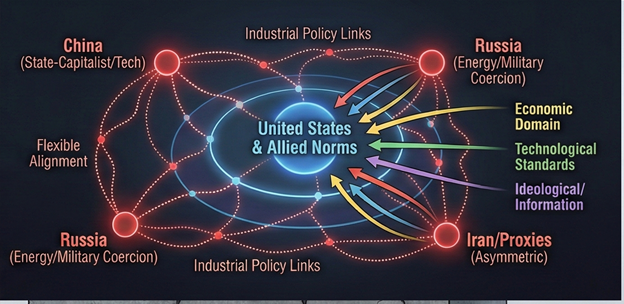
This image depicts modern competition as a system of interconnected competitors (China, Russia, Iran, and partners) applying pressure across economic, technological, and ideological and information domains. It reinforces the claim that today’s rivalry is not simply bilateral or military, but an integrated contest requiring the United States to synchronize strategy across instruments of national power.
The Core Problem: Fragmentation, Not Weakness
The United States possesses unmatched military capability, global alliances, economic strength, and technological innovation. Yet these advantages are undermined by structural fragmentation.
Strategy documents exist. The National Security Strategy, National Defense Strategy, and other policy frameworks provide guidance. But they are episodic, administration-dependent, and often disconnected from one another. They do not function as a unified system.
The issue is not capability. It is architecture.
This fragmentation produces four critical vulnerabilities:
- Reactive policy instead of anticipatory strategy
The United States often responds to crises rather than shaping the environment before they emerge. - Inconsistent signaling to allies and adversaries
Without coherence, messaging becomes fragmented, weakening deterrence and trust. - Inefficient use of national resources
Agencies pursue parallel or conflicting objectives without synchronization. - Loss of decision advantage
In a fast-moving strategic environment, delayed or disjointed decisions create exploitable gaps.
The result is a nation that remains powerful but increasingly outpaced in strategic execution.

This image illustrates how core US strategy documents and policy systems (National Security Strategy priorities, National Defense Strategy military means, and economic and diplomatic resources) often operate in separate pillars, producing disconnected effort and short-term execution. It supports the argument that the United States needs an enduring Grand Strategy Directive to unify ends, ways, and means around long-term national interests.
Why a Grand Strategy Directive Is Necessary
Grand strategy is not a new concept. It has guided the United States during its most consequential periods of competition, including World War II and the Cold War. In those eras, national objectives, resources, and actions were aligned over time.
Today, no such enduring framework exists.
A National Grand Strategy Directive would not replace existing strategies. Instead, it would unify them under a single organizing structure that defines:
- Enduring national interests
- Long-term strategic objectives
- Measurable benchmarks for success
- Roles and responsibilities across agencies
- Mechanisms for continuous assessment and adjustment
This transforms strategy from a static document into a dynamic system.
Without this, each administration resets priorities, agencies pursue divergent goals, and progress cannot be measured across time. National security becomes a collection of disconnected initiatives rather than a coordinated campaign.
A Grand Strategy Directive provides continuity. It establishes a durable foundation that transcends political cycles and aligns the instruments of national power.
The Analytic Gap: The Hidden Vulnerability
Even when leaders agree on strategic goals, the United States lacks a shared analytic framework to assess whether it is succeeding.
This is a critical weakness.
Different agencies operate with different data sets, methodologies, and timelines. Intelligence assessments are separated from economic analysis. Military posture is evaluated independently of financial leverage. Information operations are treated as distinct from diplomatic efforts.
Leaders are presented with fragments instead of an integrated picture. This is the analytic gap.
Closing this gap requires more than better reporting. It requires a unified architecture that integrates all elements of national power into a single framework.
The Solution: Integrating DIMEFIL, PMESII-PT, and ASCOPE
The United States already possesses the foundational frameworks needed to build this system. They are widely used across the Department of War and the inter-agency. The problem is that they are not integrated at the national level.
The proposed architecture fuses three key frameworks:
- DIMEFIL: Instruments of National Power
Diplomatic, Informational, Military, Economic, Financial, Intelligence, and Law Enforcement tools define how the United States acts.
- PMESII-PT: Strategic Environment
Political, Military, Economic, Social, Information, Infrastructure, Physical Environment, and Time variables define the environment in which competition occurs.
- ASCOPE: Operational Context
Areas, Structures, Capabilities, Organizations, People, and Events provide granular, human-level understanding of the operational space.
Individually, these frameworks are powerful. Together, they become transformative.
By integrating them into a unified system, the United States can:
- Map how actions in one domain affect outcomes in another
- Identify patterns across multiple dimensions of competition
- Establish measurable indicators of progress or decline
- Build predictive models that anticipate adversary behavior
This creates a shared analytic spine for national decision-making.
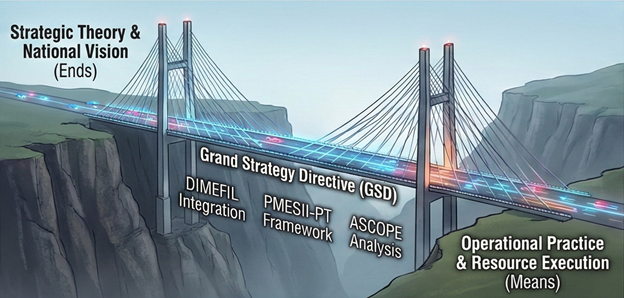
This image depicts the Grand Strategy Directive as an integrating bridge that connects strategic theory and national vision (ends) to operational practice and resource execution (means), using DIMEFIL integration, PMESII-PT framing, and ASCOPE analysis. It reinforces the concept that US strategy remains fragmented without a unified architecture capable of translating national objectives into synchronized interagency execution.
From Reactive to Predictive: The TITAN (Total Integrated Architecture)
The next step is operationalizing this integrated framework into a predictive decision architecture.
This is where the TITAN concept becomes essential.
TITAN is not just a model. It is a system designed to provide continuous, real-time assessment of strategic competition. It integrates data across all instruments of national power and translates it into actionable insights.
TITAN:
T – Total
- Covers the full spectrum of national power (DIMEFIL)
- Encompasses all domains: land, maritime, air, space, cyber, informational
- Includes state, non-state, and hybrid threats
I – Integrated
- Combines PMESII-PT + ASCOPE + DIMEFIL
- Eliminates stovepipes across:
- DoW
- Intelligence Community
- State
- Inter-agency
- Treasury
- Allies/partners
- Produces a unified operational picture
T – Threat
- Focuses explicitly on:
- Great power competition (China, Russia)
- Regional actors (Iran, DPRK)
- Non-state actors (terror networks)
- Emerging threats (AI, cyber, economic coercion)
- Prioritizes centers of gravity and critical vulnerabilities
A – Analysis
- AI/ML-enhanced analytics
- Scenario modeling and war-gaming
- Risk scoring and probability forecasting
- Continuous feedback loop for model refinement
N – Network
- Distributed, real-time decision-support system
- Connects:
- National leadership
- Combatant commands
- Interagency partners
- Enables synchronized, rapid decision-making
This enables several critical capabilities:
- Strategic Visibility
Leaders can see how economic coercion, cyber activity, military movements, financial flows, and information campaigns interact as part of a single adversary strategy.
- Comparative Analysis
The United States can measure its position relative to competitors across multiple domains simultaneously.
- Early Warning
By identifying patterns and thresholds, the system can detect when adversaries are preparing to escalate before a crisis occurs.
- Decision Synchronization
Policy responses can be coordinated across diplomatic, military, economic, and informational domains in real time.
This is the difference between reacting to events and shaping them.

This image illustrates TITAN’s integrated assessment architecture by nesting US national interests and benchmarks into PMESII-PT strategic environment assessment, ASCOPE observable entities and actions, and DIMEFIL instruments of national power. It supports the argument that predictive grand strategy becomes executable when frameworks are fused into a measurable system that produces scoreboards and alerts for decision advantage.
Real-World Application: Learning from Current Conflicts
The absence of such a system has already had tangible consequences.
Russia-Ukraine War
A unified predictive architecture could have integrated intelligence indicators, energy dependencies, financial movements, military posture, and information campaigns into a comprehensive warning model. This would have provided earlier insight into the likelihood and timing of Russian escalation.
More importantly, it would have enabled the United States to shape the environment before the invasion, rather than responding after it began.
Taiwan Strait
The stakes are even higher. A conflict over Taiwan would have global consequences.
A predictive system could integrate:
- Chinese military movements
- Cyber intrusions
- Shipping patterns
- Economic pressure
- Information operations
This would create a strategic warning matrix capable of distinguishing between exercises and actual invasion preparations.
Deterrence depends on clarity. Without integrated visibility, miscalculation becomes more likely.
Why Now: The Urgency of Strategic Competition
The question is not whether the United States should adopt a Grand Strategy Directive and predictive architecture. The question is why it has not already done so.
Time is not neutral in strategic competition. It favors those who act with coherence and consistency.
China operates on decades-long timelines. It aligns industrial policy, technological development, and military modernization with long-term strategic goals. Russia and Iran, though different in scale, follow similar patterns of integrated planning.
The United States cannot afford to operate on fragmented timelines while its competitors execute synchronized strategies.
The urgency is driven by three factors:
- Speed of Change
Technological advancements, particularly in artificial intelligence, cyber capabilities, and data analytics, are accelerating the pace of competition.
- Complexity of the Environment
Strategic competition now spans multiple domains simultaneously. Actions in one domain have cascading effects across others.
- Narrowing Margins
The gap between the United States and its competitors is shrinking in key areas, particularly in technology and economic influence.
Delaying action increases risk. It reduces strategic options and cedes initiative to adversaries.
Why This Matters: Restoring Decision Advantage
At its core, this effort is about restoring decision advantage.
Decision advantage is the ability to understand the environment faster, more accurately, and more comprehensively than competitors, and to act on that understanding effectively.
Without a unified strategy and predictive architecture, decision advantage is lost.
Leaders are forced to make decisions based on incomplete information. Coordination across agencies becomes slow and inconsistent. Opportunities to shape outcomes are missed.
With a Grand Strategy Directive and integrated analytic system, decision advantage is regained.
The United States can:
- Anticipate rather than react
- Align actions across all instruments of power
- Measure progress and adjust in real time
- Maintain strategic initiative
This is not just about efficiency. It is about survival in a competitive global system.

This image contrasts a reactive model of strategy (crisis-driven, ad hoc planning, lagging assessment) with a future state enabled by continuous monitoring, early warning detection, and synchronized options. It reinforces the idea that a Grand Strategy Directive and predictive systems convert US strategy from reactive execution into proactive shaping and sustained advantage.
Implementation: The Role of the NDAA
The National Defense Authorization Act (NDAA) provides the ideal mechanism to initiate this transformation.
Embedding the Grand Strategy Directive and predictive architecture within the NDAA accomplishes several objectives:
- Institutionalization
It ensures that the framework is not tied to a single administration but becomes part of enduring national policy. - Resource Alignment
It enables funding and prioritization across the Department of War and the interagency. - Legislative Oversight
It provides accountability and continuity through congressional engagement. - Whole-of-Government Integration
It signals that this is not a single-agency initiative but a national effort.
The NDAA is not just a budget document. It is a strategic instrument. It can be used to shape the future of American national security.
Next Steps: From Concept to Capability
Restoring strategic coherence will not happen through rhetoric alone. It requires a disciplined transition from concept to execution – one that converts strategic intent into an enduring national capability. The path forward is practical and achievable, but it must be approached as a deliberate effort across policy, analytics, and decision support.
- Establish the Grand Strategy Directive
Define enduring national interests, objectives, and benchmarks that guide all agencies.
- Build the Analytic Integration Layer
Develop the infrastructure to integrate DIMEFIL, PMESII-PT, and ASCOPE into a unified system.
- Develop Predictive Models
Leverage data analytics and artificial intelligence to create forecasting capabilities.
- Create Strategic Dashboards
Provide senior leaders with real-time visibility into strategic competition.
- Conduct Pilot Programs
Test the system in specific regions or problem sets, such as the Indo-Pacific or energy security.
- Scale Across the Government
Expand the system to include all relevant agencies and domains.
This is not a theoretical proposition. It is a practical roadmap for translating strategy into repeatable national advantage.
A Call to Action
The United States remains the most powerful nation in the world. Its military, economy, alliances, and values provide a foundation unmatched by any competitor.
But power without coherence is insufficient.
The strategic environment has changed. Adversaries are operating with integrated, long-term strategies. The United States must do the same.
A National Grand Strategy Directive, supported by a predictive decision architecture, is not optional. It is necessary. It restores alignment across the instruments of national power. It closes the analytic gap. It enables anticipatory action. It preserves decision advantage.
Most importantly, it ensures that American power is applied with purpose, precision, and persistence.
The question is not whether the United States can afford to implement this system.
The question is whether it can afford not to. And the answer is clear.
What comes next is not further recognition of the problem. It’s building the capability to act on it.
i3CA + i3solutions combine strategic geopolitical expertise with enterprise-grade technical execution to create decision-support platforms, integrated analytic environments, and operational systems designed for complex strategic competition.
If your organization is working to operationalize predictive decision architectures or integrated strategic planning frameworks, contact Tony Thacker at tony.thacker@i3solutions.com.
No comments yet
Be the first to leave a comment!