
Designing a Predictive National Security Architecture using a multidomain analytic spine that links environment, context, and instruments on national power
- DIMEFIL (Diplomatic, Information, Military, Economic, Financial, Intelligence, and Law Enforcement instruments of national power)
- PMESII-PT (Political, Military, Economic, Social, Information, Infrastructure, Physical Environment, and Time operational variables)
- ASCOPE (Areas, Structures, Capabilities, Organizations, People, and Events civil-consideration variables)
- and Mixed-Methods Research to Synchronize the Instruments of American Power
Abstract
The United States faces strategic competitors that synchronize their diplomatic, informational, military, economic, financial, intelligence, and law enforcement instruments with deliberate precision. In contrast, the American national security system remains fragmented across dozens of federal agencies that operate on separate planning cycles, interpret threats differently, and pursue objectives without unified coordination. This article presents the methodological foundation required to create a predictive and synchronized national strategy system through a Grand Strategy Directive. It integrates three established analytic frameworks, DIMEFIL (Diplomatic, Information, Military, Economic, Financial, Intelligence, and Law Enforcement instruments of national power), PMESII-PT (Political, Military, Economic, Social, Information, Infrastructure, Physical Environment, and Time operational variables), and ASCOPE (Areas, Structures, Capabilities, Organizations, People, and Events civil-consideration variables), into a multidomain analytic spine that aligns U.S. federal agencies under shared objectives, common indicators, and unified planning rhythms. Drawing from mixed-methods research, the article outlines how qualitative inquiry, quantitative modeling, and predictive simulation validate the architecture and support continuous strategic foresight. Ethical intelligence principles ensure that the predictive system operates within constitutional boundaries and democratic oversight. The resulting architecture transforms U.S. strategy from reactive to predictive, strengthens deterrence, improves alliance coordination, enhances resource allocation, and creates a learning-based national security system capable of adapting to complex global challenges. This article serves as the methodological anchor for a three-part series on rebuilding American grand strategy and prepares the foundation for the third article, which will detail the technical implementation of the predictive model.
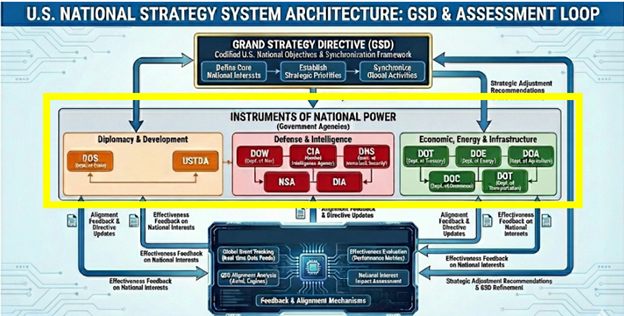
U.S. National Strategy System Architecture: Grand Strategy Directive and Assessment Loop
Note. This figure depicts the full national strategy system architecture, linking the Grand Strategy Directive (GSD) to the instruments of national power and a continuous assessment loop. In Paper 2, the highlighted area emphasizes the operational layer, where DIMEFIL instruments and their lead agencies are synchronized into unified execution and measurement. This focus supports the article’s purpose of explaining how the GSD is operationalized through interagency alignment, shared indicators, and coordinated planning cycles.
1. Introduction
The twenty-first century has been defined by the resurgence of great-power competition. Strategic rivals such as the People’s Republic of China, the Russian Federation, and the Islamic Republic of Iran employ integrated state power across diplomatic, economic, informational, financial, intelligence, and military domains to shape regional and global outcomes (Mazarr, 2019). Their strategies are not limited to traditional military confrontation. Instead, they involve coordinated long-term campaigns that fuse infrastructure investments, information operations, cyber campaigns, paramilitary activity, and political influence.
The United States remains the most capable global power in terms of resources, alliances, and technological innovation. However, its strategic posture is hampered by institutional fragmentation. National power is dispersed across the Department of State, Department of War, Department of the Treasury, Department of Commerce, Department of Justice, the Department of Homeland Security, the intelligence community, and numerous other departments and agencies. Each operates under distinct mandates, budget cycles, and planning cultures. As a result, the United States often responds to strategic challenges in a reactive, stove-piped manner rather than as a unified enterprise (Mazarr et al., 2018).
Article One in this series argued that the United States lacks a formalized grand strategy architecture that coordinates the instruments of national power in a coherent, sustained, and predictive way. It proposed a Grand Strategy Directive that would provide top-level strategic coherence and link U.S. national interests to operational and tactical execution across agencies. The present article, the second in the series, addresses the “how” question. It explains how such a directive can be grounded in rigorous methodology and operationalized through an integrated analytic framework.
The core argument is that a predictive national security architecture can be created by fusing three established frameworks: DIMEFIL, which describes the instruments of national power; PMESII-PT, which describes the macro-level strategic environment; and ASCOPE, which describes micro-level human and contextual factors. When these frameworks are integrated and validated through mixed-methods research, they form a multidomain analytic spine that can support a Grand Strategy Directive and synchronize agency activity.
The article proceeds in several steps. Section 2 defines the research problem and purpose, drawing on gaps in existing literature and practice. Section 3 presents the philosophical and methodological foundations, including research paradigms and the rationale for mixed-methods approaches. Section 4 explains how DIMEFIL, PMESII-PT, and ASCOPE can be fused into a single analytic system. Section 5 describes how this system enables synchronization of the instruments of national power across three-letter agencies. Section 6 outlines the mixed-methods research design required to validate the architecture. Section 7 describes how a predictive architecture for strategic foresight can be built. Section 8 addresses ethical intelligence and oversight. Section 9 explores implications for U.S. strategy and decision making, and Section 10 concludes by summarizing the contribution and preparing the way for the third article in the series.
2. The Research Problem and Purpose
Strategic planning scholarship has long recognized the importance of grand strategy, defined as the alignment of national objectives, instruments, and actions to protect and advance a state’s fundamental interests (Brands, 2014; Dueck, 2015). Historical cases such as the containment strategy articulated in NSC-68 (a landmark U.S. national security policy paper issued in April 1950 that fundamentally shaped Cold War strategy. It argued that the Soviet Union sought global domination and that the United States must contain its expansion through a sustained political, military, and economic mobilization. NSC-68 recommended a dramatic peacetime buildup of U.S. military forces, expanded intelligence capabilities, and stronger alliances to deter Soviet aggression. It also framed the conflict as ideological and existential, emphasizing that the struggle between freedom and totalitarianism required long-term commitment, strategic patience, and whole-of-government integration) demonstrated how an integrated approach to economic, military, political, and ideological competition can be institutionalized (Gaddis, 2005). Yet contemporary assessments repeatedly conclude that the United States lacks a comparable integrated framework for the current era of competition.
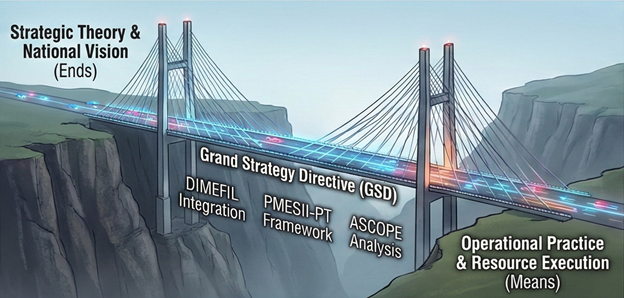
Grand Strategy Directive as the Bridge Between National Ends and Operational Means
Note. This figure depicts the Grand Strategy Directive as an integrating bridge that connects strategic theory and national vision (ends) to operational practice and resource execution (means), using DIMEFIL integration, PMESII-PT framing, and ASCOPE analysis. It reinforces the paper’s research problem that U.S. strategy remains fragmented without a unified architecture capable of translating national objectives into synchronized interagency execution.
RAND researchers have documented that U.S. strategic planning remains episodic, reactive, and fragmented across agencies, with limited mechanisms for long-range, whole-of-government coordination (Mazarr et al., 2018). National Security Strategies, National Defense Strategies, and departmental plans exist, but they do not constitute a unified system that binds agencies to shared objectives, indicators, and planning cycles. Brands (2014) and Dueck (2015) both note that U.S. grand strategy over recent decades has tended to oscillate between administrations, often without robust institutional mechanisms to ensure continuity and interagency coherence.
This fragmentation manifests in multiple ways. Diplomatic initiatives are pursued without synchronized information campaigns. Economic sanctions are implemented without fully coordinated intelligence, law enforcement, or military postures. Cyber defense efforts are often decoupled from diplomatic messaging or alliance management. Each federal organization operates effectively within its lane, but the sum of these efforts rarely achieves the synergistic effect of a truly integrated grand strategy.
The research problem, therefore, is not a lack of strategic intent but the absence of an institutionalized, empirically grounded architecture that can synchronize the instruments of national power across the U.S. federal enterprise. The purpose of this article is to design and justify such an architecture at the methodological level. Specifically, the article seeks to:
- Design a unified analytic architecture that links DIMEFIL, PMESII-PT, and ASCOPE into a multidomain framework capable of supporting a Grand Strategy Directive.
- Develop a mixed-methods research design that can empirically test whether this architecture improves interagency integration, predictive awareness, and strategic outcomes.
- Provide a foundation for technical implementation in a subsequent article, where data structures, models, and decision-support tools can be specified in detail.
By addressing these aims, the article contributes to both academic and practitioner debates on grand strategy. It proposes a framework that is theoretically grounded, methodologically rigorous, and practically oriented toward real-world planning.
3. Philosophical and Methodological Foundations
Designing a predictive national security architecture requires clear philosophical and methodological underpinnings. Research in strategic studies, organizational behavior, and complex systems has shown that no single paradigm is sufficient for understanding and managing the dynamics of modern competition (Ackoff, 1999). Instead, researchers must integrate multiple forms of knowledge, from quantitative indicators to qualitative insights and systems-level perspectives.
Four research paradigms are particularly relevant: positivism, interpretivism, critical theory, and pragmatism.
Positivism assumes that reality can be observed, measured, and analyzed through empirical data. In the strategic context, positivism underlies the use of economic indices, military balance assessments, cyber incident counts, and similar quantitative metrics. These indicators are essential for populating PMESII-PT variables and for constructing composite indices such as a Strategic Power Index. Positivist methods allow analysts to identify correlations, trends, and potential causal relationships in large datasets.
Interpretivism focuses on subjective meanings, social constructs, and human experience. Grand strategy is ultimately executed by people operating within organizational cultures and political systems. Interpretivist approaches are needed to understand how agency leaders interpret strategic guidance, how interagency trust or friction develops, and how allied and adversary perceptions influence behavior. Semi-structured interviews, focus groups, and qualitative case studies are appropriate methods for capturing these dimensions.
Critical theory examines how power, ideology, and institutional structures shape behavior. In the U.S. system, critical perspectives help explain why agencies resist integration, how bureaucratic incentives perpetuate silos, and how political cycles disrupt long-term planning. This paradigm also surfaces ethical and distributional concerns, such as which communities or allies bear the costs of specific strategies.
Pragmatism emphasizes practical consequences and the usefulness of ideas in solving real problems. It supports the integration of methods from different paradigms in a way that is guided by the research question rather than by strict philosophical allegiance (Creswell & Plano Clark, 2018). In the context of national security, pragmatism justifies a mixed-methods approach that combines quantitative modeling, qualitative insight, and systems thinking into a single research design.
Systems thinking connects these paradigms by treating national strategy as a complex system of interacting components that adapt over time (Ackoff, 1999). Diplomatic actions affect economic behavior, which influences social dynamics, which in turn affect political outcomes and security conditions. A predictive architecture must therefore capture feedback loops, nonlinearity, and emergent behavior rather than relying on linear cause and effect.
Mixed-methods research is an appropriate methodological choice because it allows the integration of these paradigms into a coherent research design (Creswell & Plano Clark, 2018). Quantitative methods provide the measurement backbone. Qualitative methods explain how institutions and individuals interpret strategy. Systems-oriented methods help integrate these insights into actionable models.
These philosophical and methodological foundations shape the design of the integrated framework and the validation approach described in subsequent sections.
4. Framework Fusion: Creating a Multidomain Analytic Spine
A predictive national security architecture needs a structure that links national objectives to measurable indicators and agency actions. The fusion of DIMEFIL, PMESII-PT, and ASCOPE provides such a structure.
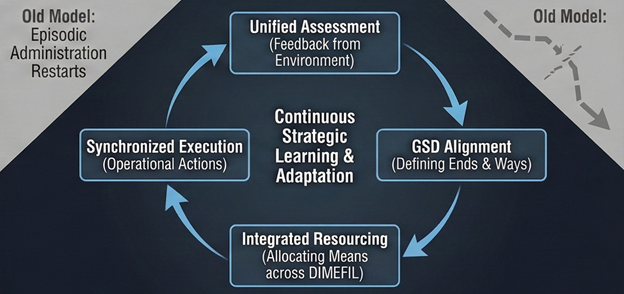
Continuous Strategic Learning and Adaptation Cycle for National Power Synchronization
Note. This figure contrasts episodic, administration-reset strategic behavior with a continuous learning cycle that integrates unified assessment, GSD alignment, integrated resourcing across DIMEFIL, and synchronized execution. It supports the paper’s claim that predictive national security architecture must be structured as a feedback-driven system that continuously aligns objectives, resources, and actions across agencies.
4.1 DIMEFIL and Federal Agency Expressions
DIMEFIL represents the instruments of national power: diplomatic, informational, military, economic, financial, intelligence, and law enforcement. To operationalize DIMEFIL, these categories must be connected to the real agencies that exercise them. Table-style mapping can be implemented in software, but conceptually the mapping includes:
- Diplomatic (D): Department of State; U.S. Agency for International Development (USAID (now under DOS)); U.S. missions to international organizations.
- Informational (I): White House communications; State Department Global Engagement Center; Department of War public affairs; elements of the Department of Homeland Security’s Cybersecurity and Infrastructure Security Agency (CISA); U.S. Agency for Global Media.
- Military (M): Department of War; Joint Staff; Combatant Commands; U.S. Special Operations Command; National Guard Bureau.
- Economic (E): Department of Commerce; Department of Agriculture; Office of the U.S. Trade Representative; Export-Import Bank; regulatory agencies such as the Federal Communications Commission in relevant domains.
- Financial (F): Department of the Treasury; Office of Foreign Assets Control; Financial Crimes Enforcement Network; Federal Reserve as an independent but interdependent actor.
- Intelligence (I): Central Intelligence Agency; Defense Intelligence Agency; National Security Agency; National Geospatial-Intelligence Agency; Office of the Director of National Intelligence; intelligence elements of the FBI, Department of Energy, and other departments.
- Law Enforcement (L): Department of Justice; Federal Bureau of Investigation; Department of Homeland Security; Customs and Border Protection; Immigration and Customs Enforcement; Drug Enforcement Administration; U.S. Marshals Service.
This mapping illustrates that the United States wields enormous capability through its three-letter agencies. The challenge is that these agencies interpret and act on strategic guidance independently. DIMEFIL provides a taxonomy, but not integration. Integration requires connecting DIMEFIL to shared environmental and contextual frameworks.
4.2 PMESII-PT: Macro-Level Strategic Environment
PMESII-PT describes the political, military, economic, social, information, infrastructure, physical terrain, and time dimensions of the strategic environment. It is widely used in operational planning but is often compartmentalized within defense circles rather than shared across civilian agencies.
In the proposed architecture, PMESII-PT acts as the macro-level lens through which all agencies view the environment. For example:
- Political indicators may include regime stability scores, alliance cohesion measures, or governance indices.
- Military indicators may include regional force balances, readiness levels, or basing patterns.
- Economic indicators may include trade dependencies, supply chain concentration, or investment flows (World Bank, 2024; IMF, 2024).
- Social indicators may include demographic trends, migration patterns, and public opinion data.
- Information indicators may include media ecosystem assessments, narrative analysis, and cyber incident data.
- Infrastructure indicators may include energy grid resilience, port capacity, and digital connectivity.
- Physical terrain and time provide geospatial and temporal context.
By standardizing PMESII-PT variables and sharing them across agencies, the architecture ensures that all actors interpret the strategic environment using a common frame.
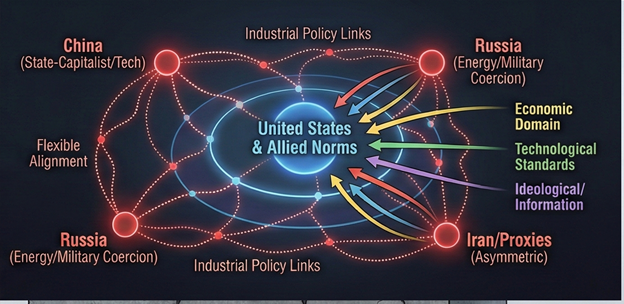
Strategic Competition as Networked Rivalry Across Domains and Actors
Note. This figure portrays strategic competition as an interconnected system in which major rivals and aligned partners apply coordinated pressure across economic, technological, and ideological or informational domains. It supports the paper’s argument that the United States must fuse environmental variables (PMESII-PT), contextual factors (ASCOPE), and instruments of power (DIMEFIL) into a single analytic spine to compete effectively in an integrated strategic environment.
4.3 ASCOPE: Micro-Level Context and Human Factors
ASCOPE adds a micro-level layer that captures the specific areas, structures, capabilities, organizations, people, and events that shape local conditions. It is particularly valuable for translating strategic objectives into theater-level and operational-level planning. Areas might refer to key maritime chokepoints or urban centers. Structures might include ports, pipelines, industrial facilities, or digital hubs. Capabilities might encompass local security forces, economic assets, or technological infrastructure. Organizations might include political parties, civil society groups, religious networks, or transnational companies. People includes key leaders, influencers, and community representatives. Events includes elections, protests, crises, or conflicts. Integrating ASCOPE ensures that strategic planning remains grounded in human and organizational realities rather than abstract variables.
4.4 Fusion Logic: The Multidomain Analytic Spine
When fused, DIMEFIL, PMESII-PT, and ASCOPE form a multidomain analytic spine that links environment, context, and instruments. PMESII-PT answers the question: What is happening in the strategic environment. ASCOPE answers the question: Where and among whom is it happening. DIMEFIL answers the question: With what tools and agencies will the United States respond. The fusion spine enables planners to trace causal chains from environmental indicators, to local context, to appropriate instruments of power. This fusion spine is the core of the predictive architecture. It gives structure to the Grand Strategy Directive by providing a common analytic language and shared mapping for all three-letter agencies.
5. Synchronizing the Instruments of National Power: Interagency Application of the Grand Strategy Directive
With the multidomain spine in place, the Grand Strategy Directive can be used to synchronize agency actions through three main mechanisms: shared objectives, common indicators, and unified planning cycles. The directive defines enduring national objectives that apply across administrations, standardized PMESII-PT and ASCOPE indicators that describe the environment, DIMEFIL-based task categories for each objective, and review cycles and decision forums where agencies coordinate responses. By anchoring agency activity to the same objectives and indicators, the directive fosters unity of effort.
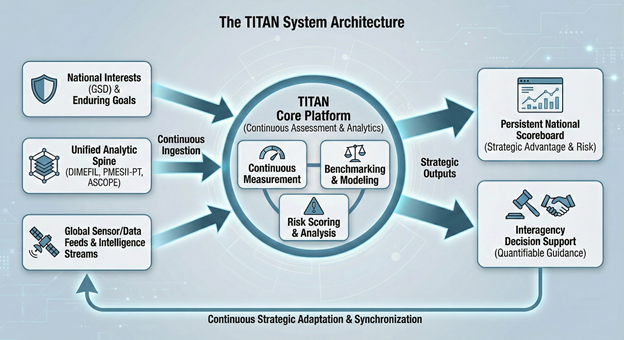
TITAN System Architecture for Continuous Assessment and Interagency Decision Support
Note. This figure illustrates the TITAN architecture as a continuous strategic platform that ingests data streams, applies measurement and benchmarking, produces risk scoring and analytic outputs, and supports interagency decision-making through quantifiable guidance. It reinforces the paper’s methodological claim that validating a predictive national security system requires measurable indicators, shared analytic structures, and repeatable assessment cycles that link strategy to outcomes.
6. Mixed-Methods Research Design for Grand Strategy Validation
A grand strategy architecture must be testable. Mixed-methods research provides a structure to evaluate whether the Grand Strategy Directive and predictive architecture actually improve coherence, foresight, and outcomes. Qualitative methods are used to understand how agencies currently interpret strategy and where friction occurs through semi-structured interviews with senior leaders and planners. Quantitative analysis provides the measurement backbone through a Strategic Power Index (SPI) that aggregates indicators across DIMEFIL domains. Predictive simulation complements statistical modeling by allowing the exploration of hypothetical scenarios using techniques such as agent-based modeling or system dynamics.
7. Building the Predictive Architecture for Strategic Foresight
With the fusion spine and research design in place, the architecture can be used to create an operational strategic foresight system. The system incorporates structured data, unstructured data, and interagency operational data into a central analytic environment. Three analytic layers transform raw data into strategic insight: environmental analysis (PMESII-PT), context analysis (ASCOPE), and instrument analysis (DIMEFIL). Specific indicators are designated as early warning signals with established thresholds that generate alerts when crossed. Feedback loops are built into the architecture to allow U.S. strategy to become an adaptive learning system.
8. Ethical Intelligence and Oversight
The integration of data, predictive algorithms, and interagency coordination creates ethical risks as well as opportunities. Key principles include respect for persons, beneficence, and justice. Algorithmic transparency, regular auditing, and independent review mechanisms help prevent bias and misuse. Congressional oversight, inspector general audits, judicial review, and public accountability mechanisms are essential institutional safeguards. Ethical intelligence is not a limitation on power but a strategic asset that enhances legitimacy, alliance trust, and long-term resilience.
9. Implications for U.S. Strategy, Decision Making, and Global Competition
Implementing a Grand Strategy Directive supported by a predictive architecture has several major implications: transformation from reactive to predictive posture, strengthened deterrence, improved alliance management, more efficient resource allocation, hybrid threat resilience, and institutional learning. These implications suggest that an integrated, predictive architecture is not merely a technical improvement but a fundamental requirement for effective grand strategy in a contested international environment.
10. Conclusion
The United States enters the coming decades with enduring advantages in resources, alliances, innovation capacity, and democratic credibility. However, advantages without orchestration do not create strategy. This article has argued that a unified strategic architecture is both necessary and achievable through integrating DIMEFIL, PMESII-PT, and ASCOPE into a multidomain analytic framework that supports continuous competitive assessment and strategic foresight. The Grand Strategy Directive provides the conceptual and institutional foundation for coherence and accountability. Together, these components transform U.S. national security from a fragmented and reactive enterprise into one that is synchronized, measurable, anticipatory, and strategically adaptive.
The third article in this series will move from conceptual design to operational execution. It will describe the required data structures, analytic workflows, indicators, interoperability standards, and cross-agency dashboards that allow continuous strategic assessment at both national and institutional levels. The national security environment of the next half century will not reward episodic decision making or reactive posture. Congress and policymakers should view unified strategic synchronization and data-driven foresight as a national priority.
References
Ackoff, R. L. (1999). Recreating the corporation: A design of organizations for the 21st century. Oxford University Press.
American Psychological Association. (2020). Publication manual of the American Psychological Association (7th ed.).
Belmont Report. (1979). Ethical principles and guidelines for the protection of human subjects of research. U.S. Department of Health, Education, and Welfare.
Brands, H. (2014). What good is grand strategy? Power and purpose in American statecraft from Harry S. Truman to George W. Bush. Cornell University Press.
Braun, V., & Clarke, V. (2006). Using thematic analysis in psychology. Qualitative Research in Psychology, 3(2), 77–101.
Creswell, J. W., & Plano Clark, V. L. (2018). Designing and conducting mixed methods research (3rd ed.). Sage.
Dueck, C. (2015). The Obama doctrine: American grand strategy today. Oxford University Press.
Gaddis, J. L. (2005). Strategies of containment: A critical appraisal of American national security policy during the Cold War (Rev. ed.). Oxford University Press.
International Monetary Fund. (2024). World economic outlook database. https://www.imf.org
Mazarr, M. J. (2019). Competitive strategy in the age of AI. RAND Corporation.
Mazarr, M. J., Miranda, M. L., & Mattock, M. G. (2018). The U.S. Department of Defense’s planning process: Components and challenges. RAND Corporation.
SIPRI. (2024). SIPRI military expenditure database. Stockholm International Peace Research Institute. https://www.sipri.org
SWIFT Institute. (2023). Global payments data review. SWIFT Institute Reports.
World Bank. (2024). World development indicators. https://data.worldbank.org
About the Author
Col Tony Thacker, USA (Ret.), is a national-security strategist and senior advisor to U.S. government organizations. He currently serves as Vice President at i3Solutions, a cutting-edge technology and analytics firm, where he leads work in strategic planning, predictive modeling, and interagency integration.
A retired special-operations officer with multiple combat deployments, Col Thacker has held leadership and policy roles across joint, interagency, and multinational environments. His work focuses on integrating frameworks such as DIMEFIL, PMESII-PT, and ASCOPE with predictive analytics, building decision-advantage tools for strategic competition. He has published widely on foresight, national resilience, and grand-strategy modernization, including articles featured at i3CA.com.
Col Thacker is a doctoral candidate at the European Institute for Management & Technology (EIMT), where his research advances the development of a unified grand-strategy system for the United States linking classical strategic theory with modern AI enabled foresight.
His views are his own and do not represent any government agency.
Disclaimer
The views expressed are those of the author and do not represent the official position of any government agency.
Appendix A. Acronyms and Key Terms
ASCOPE (Areas, Structures, Capabilities, Organizations, People, Events). A micro-level framework capturing human networks and operational context so planning stays grounded in real actors and systems.
CBP (Customs and Border Protection). A DHS law-enforcement component referenced as part of DIMEFIL execution.
CCMD (Combatant Command). A DoD/Department of War operational command responsible for regional or functional military missions.
CISA (Cybersecurity and Infrastructure Security Agency). A DHS component referenced in the informational and cyber defense instrument mapping.
CIA (Central Intelligence Agency). An intelligence agency referenced as part of the Intelligence instrument.
Critical Theory. A research paradigm used to examine power, institutions, and structural constraints that can inhibit interagency integration.
DHS (Department of Homeland Security). A department referenced as contributing to cyber defense and law enforcement within national power coordination.
DIA (Defense Intelligence Agency). A defense intelligence organization referenced as part of the Intelligence instrument.
DIMEFIL (Diplomatic, Informational, Military, Economic, Financial, Intelligence, Law Enforcement). A taxonomy of national power instruments that becomes actionable when mapped to real agencies and synchronized through shared objectives and indicators.
DoD / Department of War. The principal military department referenced for military instrument execution (noting the paper’s “Department of War” label).
DoJ (Department of Justice). A department referenced as central to the Law Enforcement instrument and related national security enforcement functions.
Ethical Intelligence. A governance approach requiring transparency, auditing, and oversight so predictive systems operate within constitutional and democratic constraints.
FinCEN (Financial Crimes Enforcement Network). A Treasury bureau referenced as part of the Financial instrument mapping for illicit finance detection and enforcement.
Fusion Spine (Multidomain Analytic Spine). The integrated logic that connects PMESII-PT (environment), ASCOPE (context), and DIMEFIL (instruments) into one analytic structure.
ICE (Immigration and Customs Enforcement). A DHS law-enforcement component referenced in the Law Enforcement instrument mapping.
Interpretivism. A research paradigm emphasizing meaning, culture, and how agencies interpret strategy, commonly examined through qualitative methods.
Mixed-Methods Research. A research design combining qualitative inquiry, quantitative modeling, and predictive simulation to test whether integration improves outcomes.
NGA (National Geospatial-Intelligence Agency). An intelligence agency referenced in the Intelligence instrument mapping.
NSA (National Security Agency). An intelligence agency referenced in the Intelligence instrument mapping.
OFAC (Office of Foreign Assets Control). A Treasury office referenced as central to sanctions and coercive finance enforcement.
ODNI (Office of the Director of National Intelligence). The coordinating office for the Intelligence Community referenced in the Intelligence instrument mapping.
PMESII-PT (Political, Military, Economic, Social, Information, Infrastructure, Physical Environment, Time). A macro-level framework describing the strategic environment used to standardize variables across agencies.
Positivism. A research paradigm emphasizing measurable reality and empirical validation, supporting indicator-based national power measurement.
Pragmatism (Research Paradigm). A paradigm focused on what works to solve applied problems, supporting mixed-methods designs guided by the research question.
SPI (Strategic Power Index). A quantitative index that aggregates indicators across DIMEFIL domains to provide a measurement backbone for strategy validation.
Thresholds (Early Warning Thresholds). Predefined alert conditions tied to indicators that trigger review when risk is rising or posture is deteriorating.
USAID (U.S. Agency for International Development). A U.S. agency referenced in the diplomatic instrument mapping (noting the paper’s “USAID under DOS” framing).