


The Center of Gravity China Is Actually Targeting
My last post was about observation – what China is collecting from the Iran conflict, how it is processing that data, and what it means for a future scenario over Taiwan. Most analysts stop there, and that is the problem.
There is another layer to this that almost nobody is talking about. China is not only watching how the United States fights. It is watching what would make the United States stop fighting. The center of gravity in any potential conflict over Taiwan is not the carrier strike groups, the air wings, the undersea fleet, or the logistics chain. It is the American people. Their willingness to sustain a fight, absorb cost, and stay in a conflict long enough for military capability to matter.
China knows this. And China is not waiting until a crisis to start targeting it.
Center of Gravity as a Concept
Center of gravity is one of the most used and least understood terms in strategic planning. It comes from Clausewitz, but you don’t need to have read Clausewitz to understand what it means in practice. The center of gravity is the source of strength that allows a force to act. It is not the force itself. It is the thing that holds the force together and keeps it in the fight. Destroy the center of gravity, and the force collapses, regardless of how capable it looks on paper.
In American strategic history, that center of gravity has been the same thing over and over again: the willingness of the American public to sustain a conflict. When the public supports a fight, the United States can project power indefinitely. When the public turns, everything downstream, such as funding, political authorization, and alliance cohesion, starts to come apart. It does not matter what the military is capable of doing if the political will to let it do it is gone.
This is not a new observation. Every adversary the United States has faced in the last fifty years has understood it to some degree. What matters now is that China does not just understand it. China is building a plan around it.
The Tet Offensive Lesson
The clearest example of this in American history is the Tet Offensive. In 1968, Ho Chi Minh launched a coordinated attack across South Vietnam during the Tet holiday. Militarily, it failed. North Vietnamese and Viet Cong forces took enormous casualties and held none of the objectives they seized. By every tactical measure, Tet was a defeat for the forces that launched it.
It was also the moment the United States began losing the war.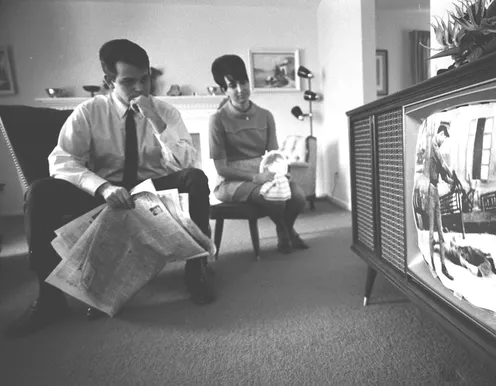 The attack was never aimed at the military. It was aimed at the American living room. At the gap between what the public had been told about how the war was going and what they were now seeing with their own eyes. The Tet Offensive did not destroy American military capability in Vietnam. It destroyed the American public’s belief that the war was winnable and worth continuing. Once that belief broke, the political will broke with it.
This is not a history lesson. This is a planning precedent that every serious adversary of the United States has studied since. You do not have to defeat the American military to defeat the United States. You have to defeat the American public’s willingness to use it. For an adversary that cannot match the US capability platform for platform (and China knows it cannot, not yet), that lesson is the template.
Why China Is Studying This Now
The same data that feeds military planning feeds information operations planning. When China watches how the United States responds to a crisis in the Middle East, it is not only learning where the gaps in capability are. It is learning where the gaps are in the narrative. What causes political friction at home? What kinds of casualties generate what kinds of public reaction? What tempo of operations will the American public tolerate before patience starts to erode? Every one of these gaps is a target.
And the critical point is this: China is not waiting for a Taiwan scenario to begin that targeting. The preparatory phase is now. The influence campaigns, the information shaping, the seeding of narratives that will be activated later, that work is already running. By the time a Taiwan crisis is active, the American public will have been conditioned for years by information they did not know was strategic.
The goal is not to convince Americans of any single thing. The goal is to make the information environment so fractured, so saturated with conflicting narratives and eroded trust, that when the moment comes, and political will is required to sustain a fight, it is not there. Not because it was destroyed in the moment, but because it was hollowed out over the years.
The information attack on the American center of gravity is not a future event. It is a current event. And every day that it runs without a coherent response, the environment gets softer.
What the US Has to Do in Advance
The response to this cannot start when the crisis starts. If it does, it is already too late. Trying to build public resilience in the middle of a crisis is like trying to lay a foundation after the building is already under load.
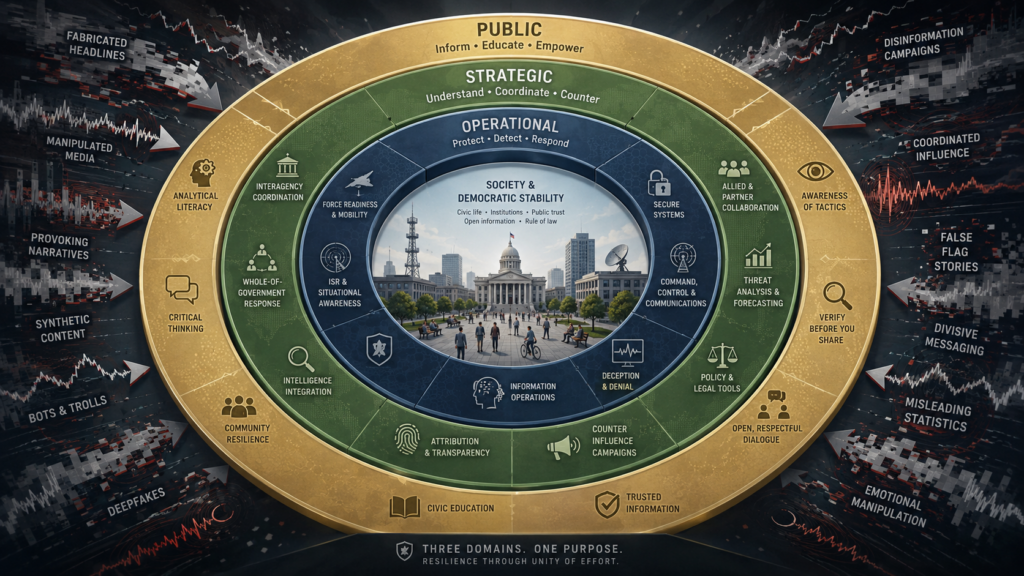
What has to happen now is straightforward to describe and difficult to execute. Information operations. Deception operations. Deterrence in the information domain, making it clear that influence campaigns will be identified, attributed, and countered. And the piece that is hardest for institutions to do well: preparing the American people in the early stages for what could happen later.
That last point is not about spinning the public or manufacturing consent. It is about building analytical literacy. The American public needs to understand the strategic environment they are living in, not in classified terms, but in terms accurate enough to make the information environment harder to manipulate. When people understand that influence operations are running, those operations become less effective. Right now, the public is a soft target.
This has to run across three domains simultaneously. Operationally, the force has to prepare its own information and deception capabilities for a contested environment. Strategically, the interagency apparatus has to identify and counter influence campaigns before they reach maturity. And publicly, leaders have to be willing to have honest, early conversations about what the strategic picture looks like. This is not to create alarm, but to close the gap between reality and public perception before an adversary can exploit it.
None of this is optional. And none of it works if it starts at the point of crisis.
Why This Is Not Panic
I am not saying a conflict over Taiwan is inevitable. I am not predicting a timeline. I am not saying the information environment is already lost. What I am saying is that there is a vulnerability being actively targeted, and the response is not moving at the speed the threat requires.
This isn’t about panic. It’s about urgency. Panic leads to bad decisions, reactive postures, and threat inflation that makes the problem harder to solve. Urgency leads to preparation. It leads to doing the work now, in the early stages, so that when the environment shifts (and it will shift), the institutions and the public they serve are not starting from zero.
Connecting the Data to the So-What
This is why we do this work. The observation picture from the first post and the center of gravity argument in this one are not separate problems. They are one connected strategic picture. China is watching how the United States fights, so it can plan how to fight, and the fight it is planning is not limited to the military domain. The data does not mean anything until you connect it to the so-what. The so-what is that the center of gravity is being targeted now, not later, and the response has to match that timeline.
The purpose of everything I have laid out across these two posts is not to sound an alarm. It is to help the people responsible for these problems take positive action to identify them and respond to them. That is what analysis is for. Not to describe the threat and walk away from it, but to describe the threat and hand the reader a job.
i3CA combines strategic geopolitical expertise with enterprise-grade technical execution through i3solutions to help organizations build the analytic frameworks, influence countermeasure capabilities, and decision-support environments required to defend the center of gravity before it is targeted.
If your organization needs support integrating center of gravity analysis into information operations planning, influence campaign detection, or strategic communication preparation, contact me at tony.thacker@i3solutions.com.
No comments yet
Be the first to leave a comment!